Ask a Red Sox fan about October 3, 1978, and watch their face change.
Ask a Yankees fan about October 20, 2004, and you’ll get a long pause before they answer.
That’s the thing about the red sox vs new york yankees timeline. It doesn’t just live in record books.
It lives in people. Fathers pass down the heartbreaks to their kids the way other families pass down furniture.
The games are almost secondary. What matters is what they meant — to a city, a clubhouse, a generation of fans who built part of their identity around this rivalry, whether they wanted to or not.
Over a century of baseball separates the first pinstripe game from the last wild card walk-off.
What fills that space is the kind of drama that makes this the only rivalry in American sports that truly requires its own timeline.
Red Sox vs New York Yankees Timeline
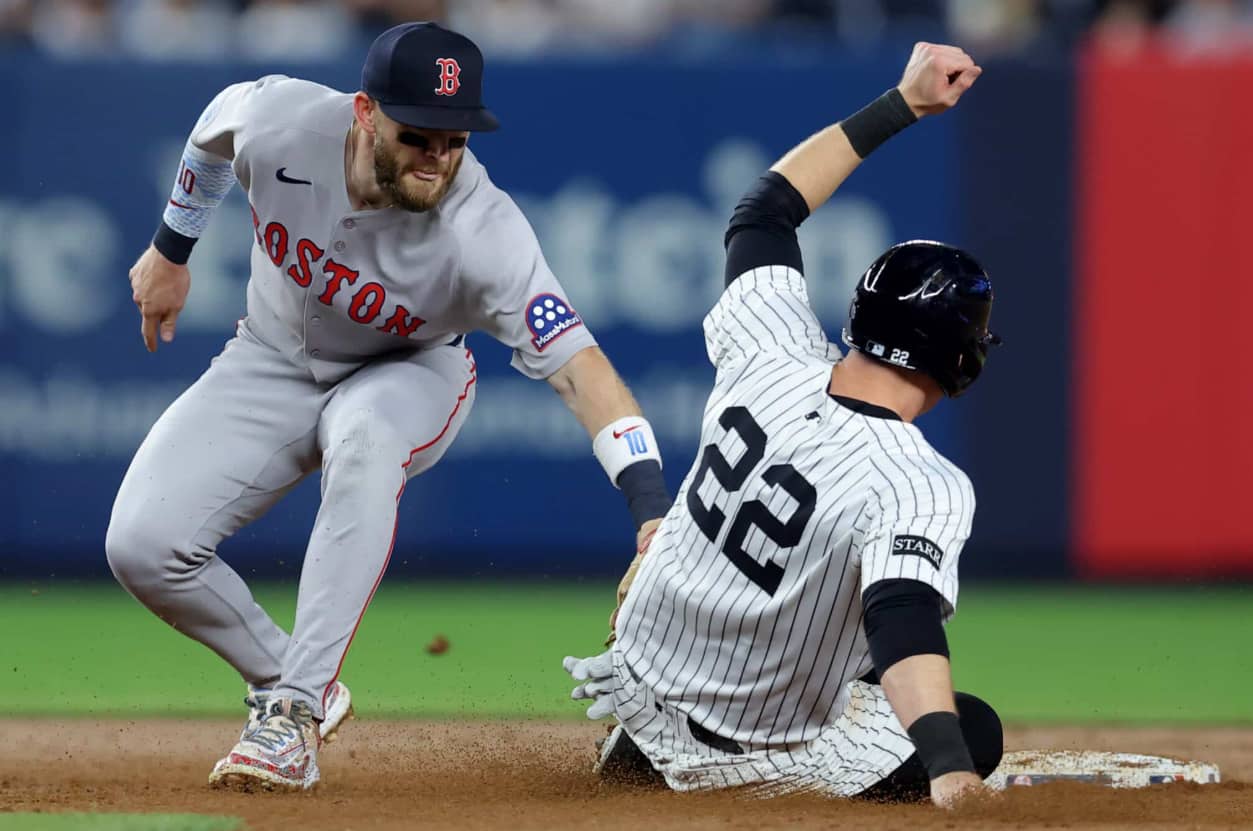
Here’s that timeline — complete, honest, and built around the moments that explain why none of this has ever felt like just baseball.
The Full Yankees and Red Sox Timeline — Complete Reference Table
| Year | Date | Moment | Result | Significance |
|---|---|---|---|---|
| 1912 | Apr 11 | Yankees debut pinstripes vs. Red Sox — Opening Day | Red Sox win, 5–3 | New York’s iconic uniform arrived in a loss to Boston |
| 1912 | Apr 20 | Fenway Park opens — Red Sox vs. Yankees | Red Sox win, 7–6 (12 inn.) | Tris Speaker’s walk-off single in the 12th; Boston won the World Series that fall |
| 1915 | May 6 | Ruth hits first career home run — Red Sox vs. Yankees at Polo Grounds | Yankees win, 4–3 (13 inn.) | 20-year-old Ruth homered off Jack Warhop; still pitching for Boston at the time |
| 1920 | Jan 5 | Red Sox sell Babe Ruth to the Yankees | — | The transaction that altered the next 86 years; Boston didn’t win another Series until 2004 |
| 1923 | Apr 18 | Yankee Stadium opens — first opponent: Red Sox | Yankees win, 4–1 | Ruth hit the stadium’s first-ever home run against his former team |
| 1938 | May 30 | Cronin-Powell brawl — doubleheader at Yankee Stadium | Yankees win, 7–4 (Game 1) | The fight that continued in the tunnel under the stadium; considered the rivalry’s true beginning |
| 1939 | Jul 9 | Red Sox win both ends of doubleheader at Yankee Stadium | Red Sox win, 4–3 and 5–3 | Boston won 5 straight in New York after trailing by 13.5 games — then lost the division by 17 |
| 1941 | Jul 2 | DiMaggio extends hit streak to 45 games — vs. Red Sox | Yankees win | Broke Willie Keeler’s record at Yankee Stadium; DiMaggio hit .408 during the 56-game run |
| 1948 | Oct 3 | Red Sox beat Yankees 10–5 on final day to stay in pennant race | Red Sox win, 10–5 | Boston eliminated New York; lost a one-game playoff to Cleveland the next day |
| 1949 | Oct 2 | Yankees beat Red Sox on final day to win pennant by one game | Yankees win, 5–3 | Ellis Kinder ran out of gas in the 7th; first of five straight NY pennants followed |
| 1951 | Sep 28 | Allie Reynolds no-hits Red Sox at Yankee Stadium | Yankees win, 8–0 | Reynolds’ second no-hitter of the season against a Boston lineup that included Ted Williams |
| 1967 | Sep 10 | Yastrzemski’s Sox pound Yankees 9–1 during pennant race | Red Sox win, 9–1 | Boston won 7 of 8 vs. New York in a 14-day stretch during the “Impossible Dream” season |
| 1972 | Sep 8 | Tiant beats Yankees 4–2 to complete three-game sweep | Red Sox win, 4–2 | Boston went 4–1 vs. New York in September; lost division by half a game to Detroit |
| 1973 | Aug 1 | Fisk and Munson brawl at home plate at Fenway | Red Sox walk-off win | A genuine baseball fight; Fisk’s backup drove in the winning run after both were ejected |
| 1976 | May 20 | Pudge and Piniella brawl; Rivers separates Bill Lee’s shoulder | Red Sox win, 8–2 | Lee missed nearly two months; Yankees won the pennant that year anyway |
| 1977 | Jun 18 | Billy Martin pulls Reggie Jackson mid-inning at Fenway — national TV | Red Sox win, 10–4 | Martin had to be physically restrained from going after Reggie in the dugout; Sox swept the series |
| 1977 | Sep 14 | Reggie Jackson walk-off two-run homer in the 9th vs. Red Sox | Yankees win, 2–0 | Boston was 2.5 games back entering the game; never got closer as New York won the division |
| 1978 | Sep 7–10 | The Boston Massacre — four games at Fenway; NY outscores Boston 52–9 | Yankees sweep | Turned a 4-game Boston lead into a tie; Boston had led by 10 games in July |
| 1978 | Oct 3 | Bucky Dent home run wins one-game playoff for Yankees at Fenway | Yankees win, 5–4 | Dent had 3 HR on the season; his shot over the Green Monster became the rivalry’s defining image |
| 1983 | Jul 4 | Dave Righetti no-hits Red Sox on Independence Day | Yankees win, 4–0 | George Steinbrenner watched from his seat on his birthday as Righetti retired Boston in order through the 9th |
| 1999 | May 27 | Roger Clemens faces Red Sox for first time as a Yankee | Yankees win | The former Boston ace went 7 innings, 2 hits; Red Sox fans weren’t ready for this |
| 1999 | Oct 13 | ALCS Game 1 — Bernie Williams walk-off homer in the 10th | Yankees win, walk-off | First postseason meeting between the clubs; New York won the series 4–1 |
| 1999 | Oct 16 | ALCS Game 3 — Pedro Martinez strikes out 12 Yankees in 7 shutout innings | Red Sox win, 13–1 | Pedro at full peak; the most dominant single postseason start in rivalry history |
| 2000 | May 28 | Pedro vs. Clemens — first head-to-head matchup at Yankee Stadium | Red Sox win, 2–0 | Scoreless through 8; Trot Nixon broke it with a 9th-inning homer off Clemens |
| 2003 | Oct 11 | ALCS Game 3 benches-clearing brawl at Fenway | — | 72-year-old bench coach Don Zimmer charged Pedro; Pedro stepped aside and Zimmer hit the turf |
| 2003 | Oct 16 | ALCS Game 7 — Aaron Boone walk-off homer in the 11th off Tim Wakefield | Yankees win, walk-off | Grady Little left a gassed Pedro in the 8th with a 3-run lead; NY tied it and Boone ended it |
| 2004 | Apr 16 | ARod first appearance at Fenway as a Yankee | Red Sox win, 6–2 | A Boston-ARod deal had collapsed over the winter; Fenway showed no mercy |
| 2004 | Jul 24 | Varitek shoves ARod; Rivera blows lead; Mueller walk-off | Red Sox walk-off win | Bill Mueller’s 9th-inning homer off Mariano Rivera became the moment 2004 Boston found itself |
| 2004 | Oct 17 | ALCS Game 4 — Roberts steals; Mueller ties it; Ortiz walk-off HR (12 inn.) | Red Sox win, walk-off | Down 3–0 in the series; the most important stolen base in baseball history |
| 2004 | Oct 18 | ALCS Game 5 — Ortiz walk-off single in 14 innings | Red Sox win, walk-off | Big Papi won back-to-back elimination games; Wakefield threw 3 shutout relief innings |
| 2004 | Oct 19 | ALCS Game 6 — Schilling’s bloody sock; ARod slaps the ball away | Red Sox win, 4–2 | Umpires overruled ARod’s interference; Schilling threw 7 innings through sutures in his ankle |
| 2004 | Oct 20 | ALCS Game 7 — Red Sox complete 3–0 comeback; win pennant at Yankee Stadium | Red Sox win, 10–3 | First team in MLB history to come back from 3–0 in any postseason series |
| 2005 | Oct 1 | Yankees clinch AL East division title at Fenway; celebrate on the field | Yankees win division | New York’s 8th straight AL East title; they won it at Boston’s home park |
| 2010 | Oct 2–3 | Red Sox play spoiler — deny Yankees division title in final weekend | Red Sox win series | New York forced into wild card; beaten by Texas in the ALCS |
| 2011 | Sep 28 | Papelbon blows 9th-inning lead in Baltimore — Red Sox collapse complete | Orioles win, 4–3 | Boston lost wild card on the final night of the season; Francona fired weeks later |
| 2013 | Aug 18 | Dempster hits ARod intentionally; Rodriguez homers in response | Yankees win, 9–6 | ARod was playing through a Biogenesis suspension appeal; Dempster suspended 5 games |
| 2014 | Sep 28 | Derek Jeter’s final at-bat at Fenway — RBI single; Fenway gives standing ovation | — | Jeter’s 3,465th career hit; one of the few genuinely warm moments in 100+ years of rivalry |
| 2021 | Oct 5 | Red Sox beat Yankees 6–2 in first-ever Wild Card Game between the clubs | Red Sox win, 6–2 | Gerrit Cole lasted 6 outs; Boston eliminated New York in their own wild card game at Fenway |
Era I: Before the Curse Had a Name (1912–1938)
The rivalry didn’t start with hatred. It started with pinstripes.
April 11, 1912. The Yankees — still going by the Highlanders — wore their now-famous pinstripe uniforms in a regular season game for the first time.
The opponent was Boston. New York lost 5–3. Nine days later, the Red Sox opened Fenway Park with New York as the first visitor.
Tris Speaker singled home the winning run in the 12th. Boston won the World Series that October.
For most of the 1910s, the two teams traded talent more than blows. Ruth pitched and hit his way to three championships in Boston.
Then, on January 5, 1920, team owner Harry Frazee sold him to New York for $100,000 and a loan secured against Fenway Park.
That’s the origin point. Everything — the dynasties, the heartbreaks, the “Curse of the Bambino” — traces back to one transaction.
Ruth hit the first home run in Yankee Stadium history against his old team on April 18, 1923, a high-arcing drive off Howard Ehmke in a 4–1 New York win. The stadium was “The House That Ruth Built.” Ruth had built it by being sold.
Real enmity didn’t arrive until May 30, 1938 — a holiday doubleheader at Yankee Stadium where Boston pitcher Archie McKain threw at Jake Powell, Powell charged the mound, and Red Sox shortstop Joe Cronin intercepted him with a punch.
When both were ejected, the fight didn’t stop. It moved into the tunnel beneath the stadium, where Cronin reportedly knocked out Powell and left him there.
That’s when the rivalry got personal.
Era II: The Long Shadow of the Yankees (1939–1972)
For more than three decades, this wasn’t a rivalry between equals.
New York won American League pennants in 1936, 1937, 1938, and 1939. They won five straight from 1949 to 1953.
Twelve pennants between 1950 and 1964. The Red Sox were a very good team that kept finishing second, and second place in this division meant watching New York celebrate.
The 1949 pennant race is the era’s clearest symbol. Boston used an 11-game winning streak in September to pull into a flat-footed tie with the Yankees entering Game 154 — the final game of the year.
Manager Joe McCarthy called on 23-game winner Ellis Kinder. Kinder was running on fumes after pitching in relief three times in the previous four days. He left the game in the seventh, trailing 1–0. New York won 5–3. First of five straight pennants followed.
Joe DiMaggio’s 56-game hit streak got its most important boost against the Red Sox. On July 2, 1941, at Yankee Stadium, DiMaggio went hitless through five innings before hitting a sixth-inning line drive into the left field seats to push his streak to 45 — breaking Willie Keeler’s record.
He would hit safely in 11 more games to reach 56. Ted Williams hit .406 that same season. DiMaggio won the MVP.
The one bright spot for Boston came on October 3, 1948, when the Red Sox pounded New York 10–5 at Fenway on the final day of the season, knocking the Yankees out of a three-way pennant race.
Boston then needed to beat Cleveland in a one-game playoff the next day to win the AL, but lost. But they had sent the Yankees home, and that counted for something.
Era III: Blood at Home Plate — the 1970s Brawls
If the 1940s and 50s were about Boston finishing second, the 1970s were about Boston finishing second while also exchanging actual punches with the team that beat them.
August 1, 1973. Yankee catcher Thurman Munson came charging home on a busted suicide squeeze, colliding with Carlton Fisk at the plate with batter Gene Michael still standing in the box.
All three players ended up in a pile. Munson shoved. Fisk hit back. Both benches cleared. Both catchers were ejected. Bob Montgomery, Fisk’s replacement, singled to start the rally that won the game in the ninth.
May 20, 1976 at Yankee Stadium. Lou Piniella tried to score from second on a single to right, Fisk blocked the plate and tagged him out, and Piniella took serious exception.
Both benches cleared again. In the melee, Yankee outfielder Mickey Rivers punched pitcher Bill Lee in the back of the head, separating Lee’s pitching shoulder. Lee missed almost two months. The Yankees won the pennant.
But the decade’s defining moment had nothing to do with fists.
In 1978, Boston led the AL East by ten games in early July. By September 1st, the lead was still 6.5 games.
Then New York replaced manager Billy Martin with the calmer Bob Lemon, and something shifted. Boston stopped hitting. The Yankees started playing like a machine.
September 7–10, at Fenway: two doubleheaders, four games, 52 New York runs to Boston’s nine. The “Boston Massacre.” The lead was gone.
The season was gone. Both teams finished tied, which forced a one-game playoff on October 3.
Bucky Dent was a light-hitting shortstop. Three home runs on the season. In the seventh inning, with New York trailing 2–0, he hit a Mike Torrez pitch just over the Green Monster.
Three runs scored. The Yankees won 5–4. Red Sox fans added a word to Bucky Dent’s name, a word printed everywhere in Boston that cannot be reprinted here without an asterisk.
Era IV: Pedro and Rocket — the Greatest Pitching Feud in Rivalry History
By the late 1990s, the postseason expanded enough that these two teams finally met in October.
What followed was a three-series, five-year stretch of the most intense pitching matchups the rivalry has ever produced.
The 1999 ALCS. Game 3 at Fenway. Pedro Martinez struck out 12 Yankees in seven shutout innings. Boston won 13–1.
Pedro was operating at a level that season — 23–4, 2.07 ERA, 313 strikeouts — where it barely felt fair. Even in a series New York won in five, he made the Yankees look helpless for one afternoon.
What made the stretch even better was Roger Clemens on the other side. Clemens had been the Red Sox ace for 13 years before leaving as a free agent.
When the Yankees traded for him, it became personal. Pedro was his replacement in Boston. Both claimed to be the best pitcher of their generation.
Their first head-to-head matchup came May 28, 2000, at Yankee Stadium. Both went the distance. Scoreless through eight.
In the ninth, with two outs and a runner on first, Trot Nixon hit a two-run homer off Clemens.
Pedro loaded the bases in the bottom of the ninth but got Tino Martinez to ground out. 2–0, Boston. Pedro, in Clemens’ house, in Clemens’ building.
Then came 2003 Game 7, and the moment that temporarily broke Boston.
Aaron Boone had been 1-for-17 in the series when he stepped in against Tim Wakefield in the 11th inning of a tied Game 7.
Wakefield’s knuckleball didn’t knuckle. Boone sent it over the left-field wall. Pennant to New York.
Grady Little had left an exhausted Pedro in the eighth inning with a three-run lead, watched New York tie it, and paid for it immediately with his job.
Boston lost in the most painful way imaginable — one out from the pennant, the wrong pitcher on the mound, and a man who’d been struggling all series delivering the blow.
Era V: 2004 — The Series That Rewrote History
There is no comparable event in American sports.
Down three games to none in the ALCS, Boston needed four straight wins against the best closer in baseball history. No team in any professional sport had ever come back from 3–0 in a playoff series.
Game 4. The Yankees are leading 4–3 in the ninth. Mariano Rivera on the mound. Kevin Millar walked.
Dave Roberts pinch-ran and stole second on the first pitch. Bill Mueller singled him home. David Ortiz hit a walk-off homer in the 12th.
Game 5. Another close game, another late inning, another Ortiz walk-off — this time a single in the 14th. Tim Wakefield threw three shutout innings of relief at age 37.
Game 6 at Yankee Stadium. Curt Schilling had dislocated peroneal tendons sutured to the bone of his ankle — an improvised procedure the Red Sox team doctor had never performed in a game setting.
Blood soaked through his sock by the fifth inning. He threw seven innings, leaving with a 4–2 lead.
ARod tried to slap the ball out of Bronson Arroyo’s glove, running to first in the eighth. The umpires called him out after a long huddle. Yankee Stadium threw garbage on the field in protest. Boston held on.
Game 7 wasn’t dramatic. Boston scored six times in the first two innings and won 10–3. They celebrated the pennant at Yankee Stadium. Then won the World Series. The 86-year drought was over.
The Later Years: Spoilers, Collapses, and One Classy Good-Bye
After 2004, the rivalry lost some of its existential weight. Boston had their title — four of them by 2018.
The wins still mattered, but the losses didn’t carry the same generational dread.
In 2011, Boston’s collapse in September was dramatic enough to stand on its own.
Jonathan Papelbon blew a ninth-inning lead in Baltimore on the final night of the season — two outs, nobody on, and somehow the Orioles scored twice.
The Rays won the wild card on the same night. Francona was gone within weeks.
September 28, 2014, at Fenway stands apart from all of this. Derek Jeter was playing his final season, and as it happened, the schedule put the Yankees in Boston on the last day.
Both teams were out of the race. Jeter batted in the sixth, hit a high-hopper to third for an RBI single — the 3,465th hit of his career — and left for a pinch-runner to a standing ovation from a Fenway crowd that had spent 20 years booing him.
Not everyone stood. But enough did that you could hear it clearly.
It was the most unusual scene in rivalry history. Genuine respect, at Fenway, for a Yankee.
The most recent chapter came on October 5, 2021. First-ever wild card game between the two clubs.
Boston started Nathan Eovaldi; New York started Gerrit Cole. Cole was supposed to be the stopper. He recorded six outs.
The Red Sox hit him for two homers and chased him in the third. Boston won 6–2, ending New York’s season.
What This Rivalry Actually Is?
Over a century in, the thing that keeps the Yankees and Red Sox timeline alive isn’t just the famous moments.
It’s the structure of it — the way wins, and losses here feel different, heavier, more loaded than any other matchup in the sport.
Bucky Dent’s home run mattered because of what it cost. Dave Roberts stealing second mattered because of what it started.
Aaron Boone was hurt because of 2003 coming right after 1986, right after 1978, right after 1949. History is the weight.
Both fan bases carry it. Neither would give it up.
FAQs
- Q: What started the Red Sox vs Yankees rivalry?
The modern rivalry traces directly to the January 1920 sale of Babe Ruth from Boston to New York. Ruth had won three World Series titles with the Red Sox. He won four more with the Yankees. Boston didn’t win another championship until 2004. The sale created 84 years of scoreboard imbalance that defined both franchises.
- Q: What is the “Boston Massacre” in the Yankees-Red Sox rivalry?
It refers to four games played September 7–10, 1978, when the Yankees visited Fenway Park and outscored Boston 52–9 across two doubleheaders. New York turned a 4-game deficit into a tie and forced a one-game playoff, which they won on Bucky Dent’s home run.
- Q: Have the Red Sox and Yankees played in the postseason?
Yes, four times. The Yankees won the 1999 ALCS 4–1 and the 2003 ALCS 4–3 on Aaron Boone’s walk-off homer in Game 7. The Red Sox won the 2004 ALCS 4–3, coming back from a 3–0 deficit in the most historic comeback in baseball postseason history. Boston also won the 2021 AL Wild Card Game 6–2.
- Q: Who won more games between the Red Sox and Yankees all-time?
The two teams have played each other more than 2,200 times. The historical edge belongs to the Yankees, though the margin has narrowed considerably since Boston began winning World Series titles in 2004.
- Q: What was Pedro Martinez’s best game against the Yankees?
ALCS Game 3, October 16, 1999, at Fenway. Pedro struck out 12 Yankees in seven shutout innings, and Boston won 13–1. He was 23–4 with a 2.07 ERA that season — one of the best single-season pitching performances in baseball history — and this game is widely considered the peak of his rivalry dominance.
- Q: Why did Fenway Park give Derek Jeter a standing ovation in 2014?
September 28, 2014, was the final day of the regular season and Jeter’s farewell tour. Both teams were out of playoff contention. Jeter singled for an RBI in the sixth inning — his 3,465th career hit — and Fenway gave him a standing ovation. It was an acknowledgment that some players earn respect regardless of which uniform they wear.
Conclusion:
The red sox vs new york yankees timeline isn’t finished. It adds a chapter every season, sometimes several.
But what’s already there is enough to sustain an argument that this is the most compelling rivalry in American professional sports — not because of the stars, not even because of the stakes, but because both sides have lost in ways that still hurt and won in ways that still feel unreal.
That’s not just sports. That’s something a little harder to explain and a lot harder to forget.
Also Check:
- MLB World Series Winners List 1903-2025
- Trends That Could Shape the 2026 MLB Season
- MLB Opening Day 2026 Schedule
- Young MLB Players Poised for a Breakout 2026 Season
About the Author