India’s oldest first-class cricket tournament has been crowning champions since 1934.
The Ranji Trophy carries massive weight in domestic cricket. It’s named after Ranjitsinhji, a trailblazer who played for England back when Indian cricket was just getting started.
The 2024–25 season ended with Vidarbha on top. Their final against Kerala finished as a draw, but Vidarbha’s first-innings lead gave them the title.
That’s their third championship in less than a decade. The current 2025–26 season is rolling right now with fresh talent emerging and teams hunting for their moment.
Ranji Trophy Winners List
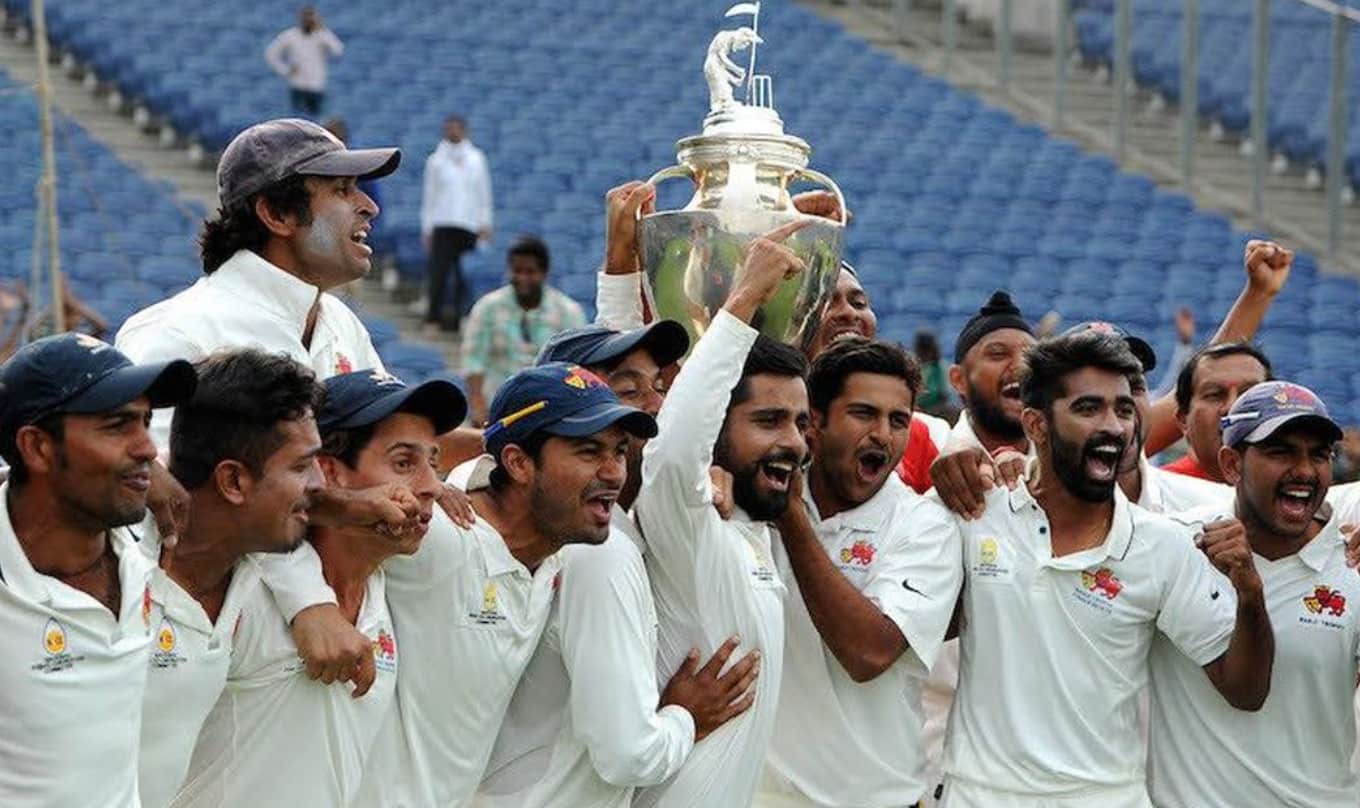
Season-By-Season Ranji Trophy Winners From 1934 To 2026
Nine decades of cricket have produced some incredible champions and heartbreaking near-misses. The Ranji Trophy winners list tells the story of Indian domestic cricket better than anything else.
Here’s every winner and runner-up since the tournament started:
| Season | Champion | Runner-Up |
|---|---|---|
| 1934-35 | Bombay | Northern India |
| 1935-36 | Bombay | Madras |
| 1936-37 | Nawanagar | Bengal |
| 1937-38 | Hyderabad | Nawanagar |
| 1938-39 | Bengal | Southern Punjab |
| 1939-40 | Maharashtra | United Provinces |
| 1940-41 | Maharashtra | Madras |
| 1941-42 | Bombay | Mysore |
| 1942-43 | Baroda | Hyderabad |
| 1943-44 | Western India | Bengal |
| 1944-45 | Bombay | Holkar |
| 1945-46 | Holkar | Baroda |
| 1946-47 | Baroda | Holkar |
| 1947-48 | Holkar | Bombay |
| 1948-49 | Bombay | Baroda |
| 1949-50 | Baroda | Holkar |
| 1950-51 | Holkar | Gujarat |
| 1951-52 | Bombay | Holkar |
| 1952-53 | Holkar | Bengal |
| 1953-54 | Bombay | Holkar |
| 1954-55 | Madras | Holkar |
| 1955-56 | Bombay | Bengal |
| 1956-57 | Bombay | Services |
| 1957-58 | Baroda | Services |
| 1958-59 | Bombay | Bengal |
| 1959-60 | Bombay | Mysore |
| 1960-61 | Bombay | Rajasthan |
| 1961-62 | Bombay | Rajasthan |
| 1962-63 | Bombay | Rajasthan |
| 1963-64 | Bombay | Rajasthan |
| 1964-65 | Bombay | Hyderabad |
| 1965-66 | Bombay | Rajasthan |
| 1966-67 | Bombay | Rajasthan |
| 1967-68 | Bombay | Madras |
| 1968-69 | Bombay | Bengal |
| 1969-70 | Bombay | Rajasthan |
| 1970-71 | Bombay | Maharashtra |
| 1971-72 | Bombay | Bengal |
| 1972-73 | Bombay | Tamil Nadu |
| 1973-74 | Karnataka | Rajasthan |
| 1974-75 | Bombay | Karnataka |
| 1975-76 | Bombay | Bihar |
| 1976-77 | Bombay | Delhi |
| 1977-78 | Karnataka | Uttar Pradesh |
| 1978-79 | Delhi | Karnataka |
| 1979-80 | Delhi | Bombay |
| 1980-81 | Bombay | Delhi |
| 1981-82 | Delhi | Karnataka |
| 1982-83 | Karnataka | Bombay |
| 1983-84 | Bombay | Delhi |
| 1984-85 | Bombay | Delhi |
| 1985-86 | Delhi | Haryana |
| 1986-87 | Hyderabad | Delhi |
| 1987-88 | Tamil Nadu | Railways |
| 1988-89 | Delhi | Bengal |
| 1989-90 | Bengal | Delhi |
| 1990-91 | Haryana | Bombay |
| 1991-92 | Delhi | Tamil Nadu |
| 1992-93 | Punjab | Maharashtra |
| 1993-94 | Bombay | Bengal |
| 1994-95 | Bombay | Punjab |
| 1995-96 | Karnataka | Tamil Nadu |
| 1996-97 | Mumbai | Delhi |
| 1997-98 | Karnataka | Uttar Pradesh |
| 1998-99 | Karnataka | Madhya Pradesh |
| 1999-00 | Mumbai | Hyderabad |
| 2000-01 | Baroda | Railways |
| 2001-02 | Railways | Baroda |
| 2002-03 | Mumbai | Tamil Nadu |
| 2003-04 | Mumbai | Tamil Nadu |
| 2004-05 | Railways | Punjab |
| 2005-06 | Uttar Pradesh | Bengal |
| 2006-07 | Mumbai | Bengal |
| 2007-08 | Delhi | Uttar Pradesh |
| 2008-09 | Mumbai | Uttar Pradesh |
| 2009-10 | Mumbai | Karnataka |
| 2010-11 | Rajasthan | Baroda |
| 2011-12 | Rajasthan | Tamil Nadu |
| 2012-13 | Mumbai | Saurashtra |
| 2013-14 | Karnataka | Maharashtra |
| 2014-15 | Karnataka | Tamil Nadu |
| 2015-16 | Mumbai | Saurashtra |
| 2016-17 | Gujarat | Mumbai |
| 2017-18 | Vidarbha | Delhi |
| 2018-19 | Vidarbha | Saurashtra |
| 2019-20 | Saurashtra | Bengal |
| 2020-21 | Not Held | Covid-19 |
| 2021-22 | Madhya Pradesh | Mumbai |
| 2022-23 | Saurashtra | Bengal |
| 2023-24 | Mumbai | Vidarbha |
| 2024–25 | Vidarbha | Kerala |
| 2025-26 | Ongoing | Ongoing |
The Tournament’s Origins And Early Days
Bombay won the first Ranji Trophy back in 1934–35. The tournament was created to honor Ranjitsinhji, who’d made history playing Test cricket for England decades earlier.
The setup was simple at first, with just a handful of teams competing.
Teams got organized into zones pretty quickly. North, West, East, and South zones each had their own competitions. Winners from each zone met in the knockout rounds.
The Central zone joined in 1952–53, expanding the reach to more cricket centers across India.
The format worked like that for about 50 years. Then in 2002–03, everything changed. The zonal system was scrapped for a two-tier structure with Elite and Plate divisions.
This new setup meant 38 teams could compete, giving smaller associations real opportunities to grow their programs.
Why Mumbai’s 42 Titles Stand Alone?
Mumbai’s record in the Ranji Trophy is absolutely bonkers. Forty-two championships over 90 years. Karnataka has 8 titles.
Delhi has 7. Nobody’s even close to touching Mumbai’s numbers. It’s not just dominance. It’s total control of an entire era.
Their 15-year winning streak from 1958–59 to 1972–73 remains unmatched in domestic cricket anywhere. Think about that stretch.
Every single season for 15 years, Mumbai won. Rajasthan made six finals during that period and lost all six to the same team. The psychological damage from that kind of losing must’ve been brutal.
What gave Mumbai such an edge? Better infrastructure came first. They had facilities other teams couldn’t match.
Coaching was more organized. The talent pool was deeper because cricket culture ran strong in the city.
Kids grew up watching winners and learned what it took. That cycle kept feeding itself for generations.
Teams Breaking Through In Recent Years
The last decade flipped the script on traditional power.
Vidarbha, Saurashtra, and Madhya Pradesh grabbed titles despite having way less history than Mumbai or Karnataka.
The tournament’s become more competitive because smaller teams have closed the gap.
Vidarbha’s three titles (2017–18, 2018–19, 2024–25) weren’t accidents. They built a squad with solid depth across batting and bowling.
When pressure hit in knockouts, they handled it better than their opponents. That mental toughness came from a belief built over multiple successful campaigns.
Saurashtra won in 2019–20 and 2022–23 by refusing to fold in tight situations. Both titles came after grinding out tough matches where things could’ve gone either way.
They play a brand of cricket that wears teams down over four days. Not flashy, but incredibly effective when the stakes are high.
Madhya Pradesh’s shocking Mumbai in the 2021–22 final stands out. A team with zero championship history beating the most successful side ever?
That result proved the field was wide open now. Any team with the right preparation and execution can win.
Expert Insight: Managing Draw Scenarios In Finals
Finals create unique pressure because draws don’t mean starting over. The first-innings lead rule changes how teams approach every session.
If you’re 80 runs ahead after day two, you’ve got insurance even if the match doesn’t finish.
This forces aggressive play early on. Teams can’t afford to bat slowly for 130 overs and make 320.
That score might be fine in a regular match, but in a final, you need to either bat huge or bowl the opposition out cheap. The margin matters as much as the result.
Smart teams use this strategically. If they’ve got a 150-run first-innings lead, they’ll attack more freely in the second innings.
Even if they lose wickets, the buffer protects them. That freedom creates interesting cricket because batters can take risks they’d normally avoid.
Conversely, teams batting behind face crushing pressure because every run feels like it weighs double.
Competition Structure Today
League matches happen in groups. Elite division teams get split into multiple pools based on strength and geography.
It keeps travel reasonable and ensures competitive balance. Top teams from each group advance to the knockout rounds.
The Plate division runs separately. These teams play fewer matches but compete for promotion spots to Elite status.
It’s a development pathway that lets emerging cricket zones build programs without getting crushed by established powers every week.
Knockouts use a standard bracket. Quarter-finals lead to semis, then a final. All matches run for four days, which is proper first-class cricket.
No gimmicks or shortened formats. Teams win by playing quality red-ball cricket over extended periods.
The Pipeline That Built Indian Cricket
Every Indian cricket star came through the Ranji Trophy system. Gavaskar, Tendulkar, Dravid, Ganguly, Sehwag, Kohli.
The list goes on forever. This tournament’s track record for producing international talent is unmatched globally.
What makes it work is the variety of challenges. A batter facing spin in Chennai learns different skills than someone playing pace in Delhi.
Adapting to different conditions, pitches, and bowlers builds complete players. That experience becomes crucial when representing India across the world.
Recent examples show the system still works. Sarfaraz Khan piled up runs in the Ranji Trophy for years before getting his India call-up.
Yashasvi Jaiswal dominated at this level and earned his chance. The pathway from domestic cricket to international remains clear and functional.
Historic Performances Worth Remembering
Mumbai’s tail-enders pulling off twin centuries in 2023–24 was insane. Tanush Kotian and Tushar Deshpande, batting at 10 and 11, both made hundreds against Baroda.
Nobody had done that in the history of first-class cricket. The odds of it happening were astronomical, but they made it look almost routine.
The Baroda-Holkar battles from 1945 to 1950 created intense rivalry. Four straight finals between the same two teams.
Each year brought a different winner. Fans waited all season to see them clash again. That kind of sustained rivalry built incredible drama.
Bengal breaking their 51-year title drought in 1989–90 hit different. They hadn’t won since 1938–39.
Multiple generations of Bengal fans had never seen a championship. When they finally got it done against Delhi, the celebrations lasted for weeks.
FAQs
- Which team dominates the Ranji Trophy winners list?
Mumbai leads all teams with 42 Ranji Trophy titles, far ahead of Karnataka’s 8 and Delhi’s 7 championships.
- Who are the latest Ranji Trophy winners?
Vidarbha won the 2024–25 Ranji Trophy by defeating Kerala based on a first-innings lead after a drawn final.
- What year did the Ranji Trophy begin?
The Ranji Trophy started in 1934–35, with Bombay winning the inaugural championship over Northern India.
- How are the Ranji Trophy finals decided?
When finals end in draws, the team leading after the first innings is declared the winner of the trophy.
- Which teams won the Ranji Trophy recently?
Recent Ranji Trophy winners include Vidarbha (2024–25, 2018–19, 2017–18), Mumbai (2023–24), Saurashtra (2022–23, 2019–20), and Madhya Pradesh (2021–22).
Red-Ball Cricket’s Premier Stage Keeps Delivering
The Ranji Trophy remains India’s most important domestic cricket competition.
Mumbai’s historic success and recent victories by teams like Vidarbha show the tournament keeps producing compelling stories year after year.
Vidarbha’s 2024–25 championship came through disciplined cricket over four days.
The drawn final against Kerala could’ve gone either way, but their first-innings advantage made the difference. That’s how championships get won at this level.
The 2025–26 season is writing new chapters right now. Players are competing for spots in state teams and ultimately for India call-ups.
The Ranji Trophy winners list will add another name when this season ends, continuing a tradition that’s been the backbone of Indian cricket for over 90 years.
Also Check:
- ICC Men’s T20 World Cup Winners List
- ISL Golden Gloves Winners List
- Hawke Cup Winners List
- ILT20 Winners List
- Sheffield Shield Winners List
About the Author