Rust skins require either time investment through gameplay or direct purchase with money.
Casual players with limited gaming hours face inefficient grinding versus immediate paid acquisition.
Understanding how to get rust skins in 2026 means evaluating time cost versus financial cost.
Each method demands different effort levels, waiting periods, and active involvement hours.
This guide compares acquisition speeds across all legitimate methods.
You’ll learn which options deliver fastest results, which require minimal effort, and which trade-offs exist between time and money.
How To Get Rust Skins in 2026?
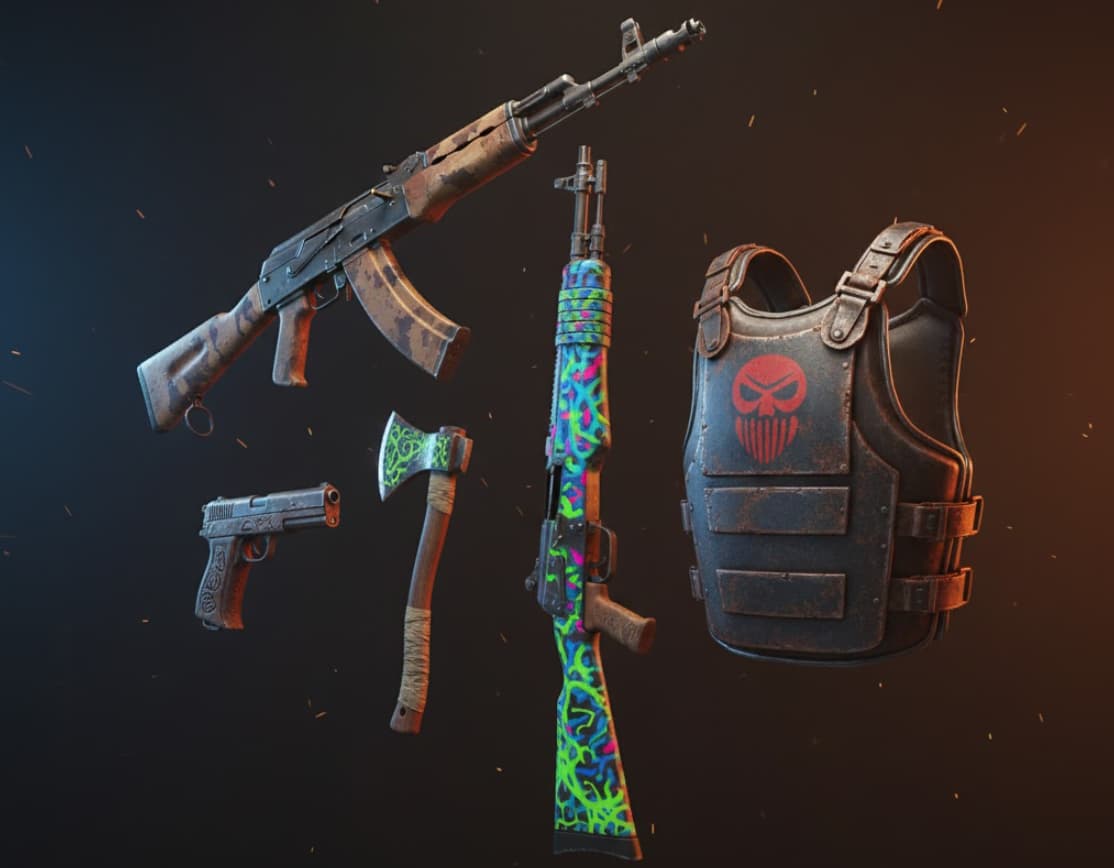
Acquisition methods are split into time-intensive and instant-delivery categories.
Time-intensive paths include weekly drops, seasonal events, and community contests requiring active participation.
Instant methods involve marketplace purchases, delivering items within minutes.
The fundamental trade-off centers on effort versus expense.
Understanding how to get Rust skins efficiently requires calculating your personal value for gaming time.
Someone playing 2 hours weekly benefits more from direct purchases than grinding systems designed for daily players.
Speed rankings from fastest to slowest:
- Steam Market purchases (instant delivery)
- Verified third-party marketplaces (minutes to hours)
- Player trading (hours to days with negotiation)
- Twitch Drops campaigns (passive but campaign-dependent)
- Weekly drop system (automatic but weekly schedule)
- Seasonal events (limited availability windows)
What are skins in Rust and how does the system work?
Rust skins modify the visual appearance of weapons, tools, clothing, and structures.
They provide zero gameplay advantages. Performance remains identical across all cosmetic variants.
Skins persist in the Steam inventory permanently. Server wipes reset in-game progress but never affect inventory holdings.
Once acquired, skins remain accessible indefinitely without maintenance requirements.
Rarity tiers determine base market values: Consumer Grade, Industrial Grade, Mil-Spec, Restricted, Classified, Covert, and Contraband.
Higher rarity typically means higher prices, though popularity and availability significantly impact actual trading values.
All legitimate inventory changes occur through Steam’s systems.
This centralization enables instant delivery for purchases but creates waiting periods for free acquisition methods.
How to Use Rust Skins?
Apply skins through the in-game inventory interface in under 60 seconds:
- Open inventory while connected to any Rust server
- Navigate to item category (weapons, clothing, tools)
- Select the desired skin from owned Steam inventory items
- Confirm the application for future crafts
Skin selection applies automatically to all future crafted instances. No repeated application needed.
The process requires zero setup beyond initial selection.
All servers recognize Steam inventory skins immediately. No compatibility checks or approval periods exist.
Once applied in inventory settings, skins appear on the next crafted item.
How to get skins in Rust just by playing: the reward system
Weekly drops operate automatically for accounts meeting playtime thresholds.
The system requires approximately 3-5 hours of gameplay per week. Drops are distributed every Thursday without manual claiming steps.
| Method | Time Required | Cost | Typical Value | Reliability |
|---|---|---|---|---|
| Weekly Drops | 3-5 hours/week | Free | $0.03–$0.50 | High (guaranteed) |
| Seasonal Events | 5-10 hours/event | Free | $0.50–$5.00 | Medium (limited periods) |
| Twitch Drops | 2-4 hours/campaign | Free | $1.00–$10.00 | Low (campaign-dependent) |
This represents the slowest but most reliable path to accumulate free rust skins for beginners.
Annual accumulation from weekly drops alone yields approximately $20-40 in total value after 52 weeks of consistent 3-hour minimum playtime.
Efficiency calculation: Weekly drops require 156-260 hours yearly for $20-40 return.
This equals $0.08-$0.26 per hour of gameplay time. Direct purchases eliminate this time investment entirely for targeted item acquisition.
Passive benefit: Drops accumulate during normal gameplay sessions. No additional effort beyond standard playing time required.
Buying on the Steam Community Market: safety and reliability
Steam Market delivers instant results. Search for specific items, complete a purchase, and receive inventory delivery within seconds. Zero waiting periods or verification delays exist.
| Aspect | Speed Advantage | Cost Factor |
|---|---|---|
| Purchase Process | 30-60 seconds from search to delivery | 15% combined fees (5% Steam, 10% game) |
| Account Requirements | Existing Steam account only | No additional setup time |
| Item Availability | The complete catalog is instantly searchable | Prices are 15-30% above third-party |
| Verification Time | None beyond standard Steam login | Immediate access to purchases |
The Rust item store functions through Steam’s marketplace infrastructure.
All transactions are processed through established Steam Wallet systems already configured for game purchases.
Efficiency assessment: Steam Market prioritizes convenience over cost.
The 15-30% price premium pays for zero verification time, instant delivery, and complete fraud protection.
For busy players, this time savings typically exceeds the dollar difference.
Time comparison: Finding and purchasing a specific skin takes 2-5 minutes versus 156+ hours through weekly drops alone.
Buying on third-party sites: cost-effective, but be careful
Third-party marketplaces reduce prices by 15-40% but add verification steps.
Initial setup requires OAuth linking and payment method configuration, totaling 10-20 minutes. Subsequent purchases process in 5-15 minutes, depending on seller availability.
| Factor | Time Impact | Efficiency Rating |
|---|---|---|
| First-time Setup | 10-20 minutes (OAuth + payment) | One-time investment |
| Item Search | 2-5 minutes | Similar to Steam Market |
| Purchase Processing | 5-15 minutes (trade offer wait) | Slower than Steam |
| Savings Potential | 15-40% price reduction | Increases with purchase volume |
Time-savings calculation: A $50 inventory purchased through third-party sites at a 25% discount saves $12.50.
The 15-20 minute verification investment pays for itself on the first purchase, exceeding $30 at typical savings rates.
Efficiency note: Bulk purchases maximize third-party platform value.
Single low-value transactions favor Steam Market due to comparable time investment without savings impact.
Trading with other players
Direct trading requires the most time of all acquisition methods. Negotiation, verification, and coordination extend single trades to hours or days.
Time breakdown for a typical trade:
- Finding trade partner: 30-90 minutes (posting + waiting for responses)
- Negotiation: 15-60 minutes (price discussion and item verification)
- Verification steps: 10-30 minutes (checking profiles and reputation)
- Trade execution: 5-15 minutes (sending offer and acceptance)
- Total: 60-195 minutes per successful trade
Efficiency assessment: Trading makes sense only for high-value items where savings exceed $20+.
For budget items under $10, the time investment rarely justifies savings versus direct marketplace purchases.
Risk-time ratio: Trading adds security verification steps that further extend the process.
Even experienced traders average 90+ minutes per completed trade, including failed negotiations.
How to get free skins in Rust 2026 via events and contests
Events and contests offer free acquisition but require specific time commitments during limited availability windows. Missing event periods eliminate the acquisition opportunity.
| Event Type | Time Commitment | Availability | Reward Value | Effort Level |
|---|---|---|---|---|
| Seasonal Events | 5-10 hours | 3-4 times yearly | $0.50–$5.00 | Medium (active gameplay) |
| Twitch Drops | 2-4 hours | Campaign periods only | $1.00–$10.00 | Low (passive viewing) |
| Community Contests | 1-10 hours | Ongoing | $1.00–$50.00 | High (creative work) |
| Streamer Giveaways | 5-30 minutes | Variable | $5.00–$100.00 | Low (follow/subscribe) |
Twitch drops provide the most efficient passive acquisition. Enable stream in the background while working or doing other activities. Campaign periods require monitoring Rust’s official announcements for activation dates.
Efficiency ranking by effort-to-value:
- Streamer giveaways (5-30 minutes, low effort, luck-based)
- Twitch drops (2-4 hours passive viewing during campaigns)
- Seasonal events (5-10 hours active gameplay)
- Community contests (variable, skill-dependent results)
Time trap warning: Community contests require creative work hours with uncertain returns. Only participate if you enjoy the creative process itself.
How to get skins on Rust servers: truths and myths
Server-based skin claims waste time on non-functional systems. No server can add items to Steam inventories regardless of claimed mechanisms.
Time trap identification:
- “Earn skins through playtime” servers: Impossible—no inventory access exists
- Skin gambling sites: High time investment, negative expected return, violates Steam ToS
- “Free skin generators”: Malware distribution designed to steal accounts
- Survey-based rewards: Lead to endless survey loops, never delivering items
Legitimate server giveaways exist but occur infrequently. Time investment monitoring server announcements rarely yield returns comparable to direct purchasing or official drop systems.
Efficiency verdict: Avoid server-based acquisition claims entirely. Time spent investigating these systems delivers better returns when applied to actual gameplay for weekly drops or working to fund direct purchases.
Which method should you choose for your collection?
Selection depends on available time versus available budget. Neither resource substitutes perfectly for the other due to method-specific constraints.
| Player Type | Time Available | Budget | Best Method |
|---|---|---|---|
| Busy casual player | <5 hours/week | $20-50/month | Steam Market purchases |
| Active player | 10-20 hours/week | $0-10/month | Weekly drops + seasonal events |
| Budget-conscious | Variable | Limited | Third-party marketplaces + drops |
| Working professional | Limited | $50+/month | Steam Market exclusively |
| Student/low-income | High | Minimal | Weekly drops + Twitch campaigns |
Time-money crossover calculation: If your hourly wage exceeds $15, direct purchases typically deliver better value than grinding free methods.
Someone earning $25/hour wastes $6.25 in opportunity cost grinding for a $3 skin through 15-minute trade negotiations.
Fastest possible skin acquisition: Steam Market delivers any available skin in under 5 minutes from decision to inventory delivery.
Most efficient free method: Twitch drops during active campaigns provide $1-10 items for 2-4 hours of passive viewing, requiring minimal active attention.
FAQs
- How to Get Skins in Rust with minimal time investment?
Purchase directly through the Steam Market. Search, buy, and receive delivery in under 5 minutes per item. Zero grinding or verification delays.
- What’s the fastest free method?
Twitch drops during official campaigns. Enable streaming in the background while doing other activities. Requires 2-4 hours viewing time but demands minimal active attention.
- Are weekly drops worth the time?
Only if you already play regularly. Don’t play solely for drops—the time-to-value ratio averages $0.08-$0.26 per gameplay hour.
- How long does third-party marketplace setup take?
First purchase requires 10-20 minutes for OAuth linking and payment setup. Subsequent purchases take 5-15 minutes. Worth the time for purchases exceeding $30 due to 15-40% savings.
- Should I trade with other players to save money?
Only for high-value items ($20+). Trading averages 60-195 minutes per successful deal. For budget items, the time cost exceeds the savings value.
Conclusion:
Understanding how to get rust skins in 2026 efficiently requires calculating your personal time value against each method’s requirements.
Different player types benefit from different acquisition strategies.
Fastest acquisition options:
- Steam Market delivers instant results in under 5 minutes per purchase
- Third-party marketplaces save 15-40% with 5-15 minute delivery after initial setup
- Twitch drops provide passive acquisition during campaign periods
Zero-cost paths:
- Weekly drops accumulate automatically during regular 3-5 hour weekly gameplay
- Seasonal events grant exclusive items requiring 5-10 hours of active participation
- Twitch campaigns deliver $1-10 items for 2-4 hours of passive viewing
Trade-offs between methods:
- Time-rich, budget-limited players benefit from drops and events
- Time-limited, budget-available players benefit from direct marketplace purchases
- A hybrid approach combining weekly drops with targeted purchases balances both resources
Calculate your hourly opportunity cost before committing time to grinding methods.
For many working players, direct purchases deliver better overall value than “free” time-intensive alternatives.
Also Check:
About the Author