College football’s 2026 season is shaping up to be special, and a big reason why is the talent staying on campus.
While several elite edge defenders declared for the 2026 NFL Draft, the cupboard is far from bare.
The top 10 returning edge defenders for the 2026 season represent a fascinating mix of established stars and emerging threats.
Some have already proven themselves as dominant forces. Others are transfer portal additions ready to make immediate impacts at their new programs.
What makes this group particularly interesting? Several players have chosen to return despite projected first-round NFL Draft status, betting on themselves to climb even higher in the 2027 class.
Best Returning Pass Rushers Ready to Dominate the 2026 Season
| Rank | Player | School | Year | Key Strength |
|---|---|---|---|---|
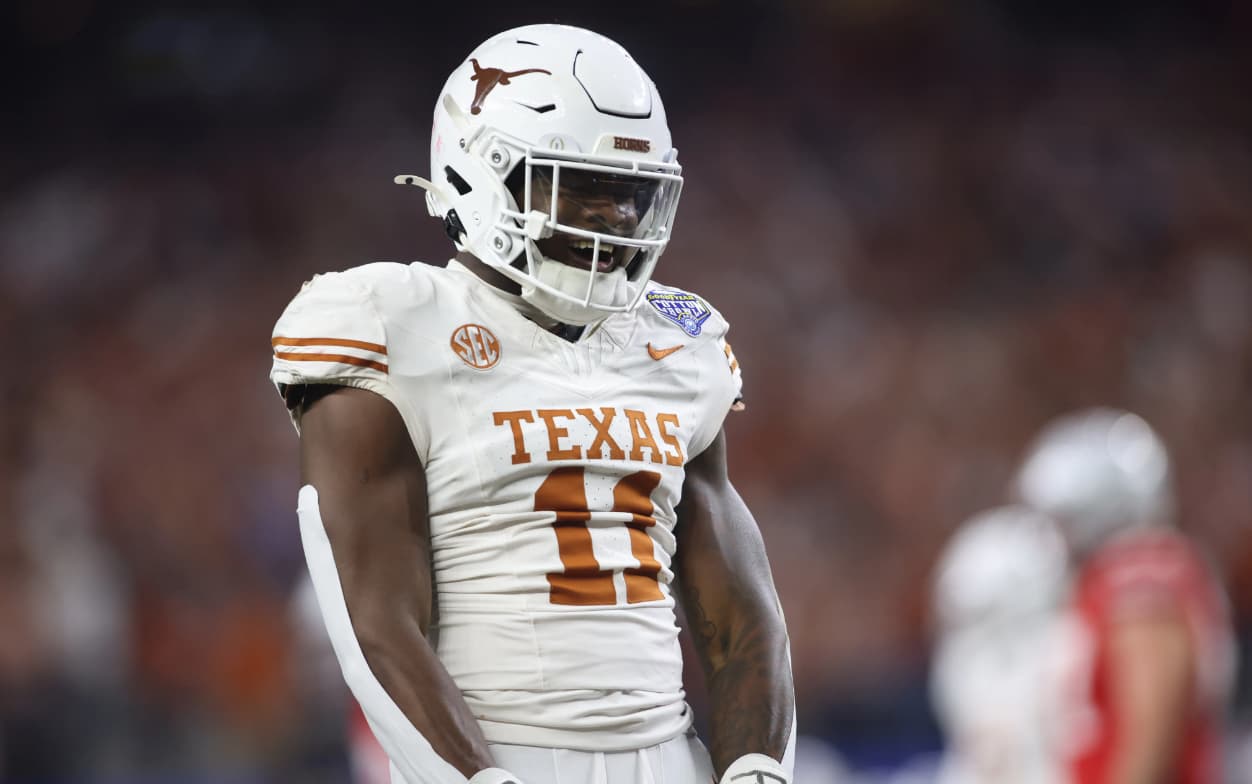
| 1 | Colin Simmons | Texas | Junior | Complete edge defender, elite pass rush & run defense |
| 2 | Clev Lubin | Louisville | Senior | Highest overall grade, most pressures among returners |
| 3 | Dylan Stewart | South Carolina | Junior | Freaky athleticism, improved run defense |
| 4 | John Henry Daley | Michigan | Junior | Elite pass-rush win rate, breakout performer |
| 5 | Teitum Tuioti | Oregon | Senior | Balanced excellence, defensive stop leader |
| 6 | Matayo Uiagalelei | Oregon | Senior | Career-best season, high pressure production |
| 7 | Suntarine Perkins | Ole Miss | Senior | Elite motor, overcomes size limitations |
| 8 | Will Heldt | Clemson | Senior | Immediate transfer impact, solid all-around |
| 9 | Damon Wilson II | Miami (FL) | Junior | High pressure volume, SEC production |
| 10 | Princewill Umanmielen | LSU | Senior | Proven sack production, strong run defender |
1. Colin Simmons, Texas
Simmons tops this list for the second straight year, joining an exclusive group of players who’ve accomplished that feat. He’s the first edge defender to lead the rankings in back-to-back seasons during the PFF College era.
His production backs up the hype. Over the past two seasons, Simmons has generated 105 pressures, ranking second among all returning edge defenders while maintaining a solid 78.7 run-defense grade. That’s the kind of complete game that makes NFL scouts drool.
| Name | Position | School | Seasons |
|---|---|---|---|
| Trevor Lawrence | QB | Clemson | 2019, 2020 |
| Derek Stingley Jr. | CB | LSU | 2020, 2021 |
| Brock Bowers | TE | Georgia | 2023, 2024 |
| Caleb Downs | S | Ohio State | 2024, 2025 |
| Jeremiah Smith | WR | Ohio State | 2025, 2026 |
| Colin Simmons | EDGE | Texas | 2025, 2026 |
No returning FBS edge rusher has been more valuable than Simmons over the past two years. He enters his junior year as the clear best edge rusher in college football and projects as a top-10 pick in the loaded 2027 NFL Draft.
2. Clev Lubin, Louisville
Lubin’s college journey reads like a roadmap across America—Army, Iowa Western, Coastal Carolina, and now Louisville. But everywhere he’s gone, one thing has remained constant: he dominates.
Lubin’s 92.8 overall grade since 2024 is the best of any returning FBS edge defender. His 110 pressures in that span? Also tops among returners.
Last season with the Cardinals, he posted 64 pressures and a staggering 24% pass-rush win rate—the highest in the Power Four.
The Cardinals struck gold in the transfer portal. Lubin brings not just production but veteran savvy from his travels. That experience shows in how he processes information and adjusts mid-game.
3. Dylan Stewart, South Carolina
Stewart placed second on this list last year but dropped one spot after a solid rather than spectacular sophomore campaign. Still, his body of work over his first two seasons and freaky tools deserve a top-three ranking.
His 88 pressures since 2024 are second only to Colin Simmons among players who’ve competed in the Power Four in each of the past two years. Stewart owns an elite 90.2 pass-rush grade in that span.
The most encouraging development? Stewart improved his run-defense grade from 61.9 as a freshman to 79.0 as a sophomore.
That progression suggests he’s committed to becoming a complete player. He has all the makings of a top-10 draft pick if he bounces back as a junior.
4. John Henry Daley, Michigan
The first of three transfers on this list, Daley followed head coach Kyle Whittingham from Utah to Michigan.
After two years on the bench at BYU and with the Utes, he finally started as a redshirt sophomore and became one of the sport’s best pass rushers.
Daley’s 93.4 pass-rush grade ranked second in the FBS, trailing only David Bailey, a projected top-five pick in the 2026 NFL Draft.
His 23% pass-rush win rate placed third in the Power Four, behind only Clev Lubin and Rueben Bain Jr., another projected top-10 selection.
The Wolverines needed someone to step up after losing key defensive line pieces, and Daley answered.
He also earned a very solid 77.6 run-defense grade, making him a complete three-down force and the next star edge defender for Michigan.
5. Teitum Tuioti, Oregon
Tuioti returns for his senior year with the Ducks, entering his third season as one of their starting edge defenders.
He posted 80.0-plus grades as both a pass rusher and run defender in 2025, the only returning Power Four edge rusher to achieve that balance.
His 47 defensive stops led the Power Four, while his 11 sacks tied for 11th in the FBS.
Those numbers reflect consistent dominance across an entire season, not just flash plays.
Tuioti ranks as the fourth-most-valuable returning Power Four edge defender according to advanced metrics.
His ability to contribute in multiple phases makes him invaluable to Oregon’s scheme.
6. Matayo Uiagalelei, Oregon
With two players in the top 10 at both edge defender and interior defensive line positions, it’s fair to say the Ducks have the best defensive line in college football entering the 2026 season.
Uiagalelei’s third season was his best, posting a career-high 82.4 overall grade in 2025.
His 52 pressures ranked 11th in the Power Four, and he earned a career-best 74.2 run-defense grade. The previous season, his nine sacks ranked 15th in the Power Four.
Having both Tuioti and Uiagalelei on the field simultaneously creates matchup nightmares for offensive coordinators.
7. Suntarine Perkins, Ole Miss
Perkins would be small even for a linebacker at 6-foot-2 and 220 pounds, but he’s still stuffed the stat sheet as a standup edge rusher in the Rebels’ defense.
The rising senior’s 79 defensive stops since 2024 rank second among players on this list, trailing only Teitum Tuioti.
His 16 sacks in that span tie for fourth most. Only Colin Simmons and Clev Lubin have been more valuable over the past two seasons.
Perkins proves that technique, motor, and relentless pursuit can overcome physical limitations.
His quick-twitch ability allows him to win despite giving up significant size to opposing tackles.
8. Will Heldt, Clemson
Clemson is losing two projected first-round picks from its defensive line in Peter Woods and T.J. Parker, but the Tigers still have a returning star in Heldt.
The Purdue transfer made an immediate impact in 2025.
He placed third among returning Power Four edge defenders with an 84.4 overall grade.
His 87.8 pass-rush grade on true pass sets ranked 14th in the Power Four, while he also logged a very solid 77.9 run-defense grade.
Heldt ties as the sixth-most-valuable returning Power Four edge defender since 2024.
His arrival proves that college football’s new landscape allows programs to quickly reload rather than rebuild.
9. Damon Wilson II, Miami (FL)
Wilson will suit up for his third school in three years after previous stops at Georgia and Missouri.
He faces big shoes to fill at Miami, replacing two projected top-20 picks in the 2026 NFL Draft—Rueben Bain Jr. and Akheem Mesidor.
His 54 pressures in 2025 with the Tigers ranked third in the SEC, while his 78.5 grade placed eighth in the conference.
The pressure production is there, but Wilson must improve as a run defender, carrying a career 59.5 run-defense grade.
Coaching from Hall of Famer Jason Taylor should accelerate Wilson’s development in Miami’s system.
10. Princewill Umanmielen, LSU
Umanmielen will feature for his third school in three years after stops at Nebraska and Ole Miss.
He followed head coach Lane Kiffin to Baton Rouge after a productive season with the Rebels.
His 11 sacks ranked second in the SEC, trailing only Cashius Howell, while his 51 pressures placed fourth in the conference.
The younger brother of Carolina Panthers edge rusher Princely Umanmielen was also solid as a run defender, placing seventh in the conference with 26 defensive stops.
Umanmielen brings both bloodlines and production to LSU’s defensive line.
Honorable Mention: Boubacar Traore, Notre Dame
Traore became one of the Fighting Irish’s starting edge rushers as a redshirt sophomore and delivered a breakout campaign.
His 10 sacks tied for 13th in the Power Four, while his 79.4 overall grade ranked in the top 30 nationally.
Traore also notched a solid 75.2 run-defense grade, showing he’s more than a one-dimensional pass rusher.
He seems to be scratching the surface of his potential.
Expert Insight: The Transfer Portal Revolution
The transfer portal has fundamentally changed how programs build elite defensive lines.
Three of the top 10 returning edge defenders in college football will play for new schools in 2026, highlighting this shift.
Gone are the days when losing star players meant multi-year rebuilds. Now, programs can immediately plug holes with proven commodities from other schools.
This creates fascinating storylines as players chase opportunities, follow coaches, or seek bigger stages.
The portal also rewards player development. Programs that identify raw talent and develop it now face the reality that their finished products might transfer for one final season elsewhere.
What Separates the Elite?
What separates the elite from the very good at edge defender? It’s not just one thing; it’s the combination of pass rush prowess, run defense consistency, and week-to-week reliability.
Colin Simmons and Clev Lubin represent different paths to dominance. Simmons is the highly-recruited phenom who’s lived up to every expectation.
Lubin is the journeyman who’s proven himself at every stop. Both are elite, but their stories couldn’t be more different.
The Oregon duo shows the value of complementary skill sets. One excels at setting the edge and stopping the run.
The other generates consistent pressure. Together, they’re greater than the sum of their parts.
FAQs
- Who is the best returning edge defender in college football?
Colin Simmons from Texas holds the top spot for the second consecutive year. He’s generated 105 pressures over the past two seasons while maintaining excellent run defense grades.
- Which school has the best edge defender duo?
Oregon features two top-10 edge defenders in Teitum Tuioti and Matayo Uiagalelei, giving the Ducks arguably the nation’s most complete defensive line.
- How many top edge defenders are transfers?
Three of the top 10 returning edge defenders will play for new schools in 2026: John Henry Daley (Michigan), Damon Wilson II (Miami), and Princewill Umanmielen (LSU).
- What makes Colin Simmons special?
Simmons combines elite pass-rushing ability with strong run defense, generating over 100 pressures in two seasons while maintaining a 78.7 run-defense grade. He’s a complete player with no weaknesses.
- Will any of these players be first-round NFL picks?
Multiple players on this list project as first-round selections in the 2027 NFL Draft, particularly Colin Simmons, Dylan Stewart, and Clev Lubin, based on their production and physical tools.
Looking Ahead to 2026
The 2026 college football season promises elite edge defender play across the country.
These 10 returners represent different paths, different stories, and different styles, but they all share one thing: the ability to wreck opposing offenses.
From Texas to Oregon to Louisville, defensive coordinators can build their schemes around proven commodities rather than hoping for breakouts.
That should lead to better defenses and more competitive games throughout the season.
The NFL Draft implications are massive, too.
These players aren’t just competing for conference championships; they’re auditioning for life-changing professional contracts.
Expect them to play with urgency and purpose all season long.
About the Author