The longest men’s singles matches in australian open history 2026 represent extreme tests of physical endurance and mental resilience.
Matches exceeding five hours place unprecedented demands on cardiovascular systems, muscular stamina, and cognitive function under fatigue.
Melbourne Park conditions contribute significantly to extended match durations.
Hard court surfaces, scheduling variables, heat patterns, and historical scoring rules without final set tiebreakers enabled marathon encounters.
Match duration records provide insight into competitive tennis evolution.
Environmental factors, rule modifications, player fitness standards, and tactical approaches all influence time-on-court extremes.
Longest Men’s Singles Matches in Australian Open History
This article documents verified duration data from official tournament records.
All times, scores, and rounds reflect authenticated Australian Open results.
The 5 Longest Men’s Singles Matches in Australian Open History Till 2026
| Rank | Match | Year | Round | Duration | Five-Set Scoreline |
|---|---|---|---|---|---|
| 1 | Djokovic vs Nadal | 2012 | Final | 5h 53m | 5-7, 6-4, 6-2, 6-7, 7-5 |
| 2 | Murray vs Kokkinakis | 2023 | R2 | 5h 45m | 4-6, 6-7, 7-6, 6-3, 7-5 |
| 3 | Nadal vs Medvedev | 2022 | Final | 5h 24m | 2-6, 6-7, 6-4, 6-4, 7-5 |
| 4 | Karlovic vs Zeballos | 2017 | R1 | 5h 15m | 6-7, 3-6, 7-5, 6-2, 22-20 |
| 5 | Nadal vs Verdasco | 2009 | SF | 5h 14m | 6-7, 6-4, 7-6, 6-7, 6-4 |
All Longest Men’s Singles Matches in Australian Open History Till 2026
1. Novak Djokovic v Rafael Nadal – 2012 Final
Total match duration impact
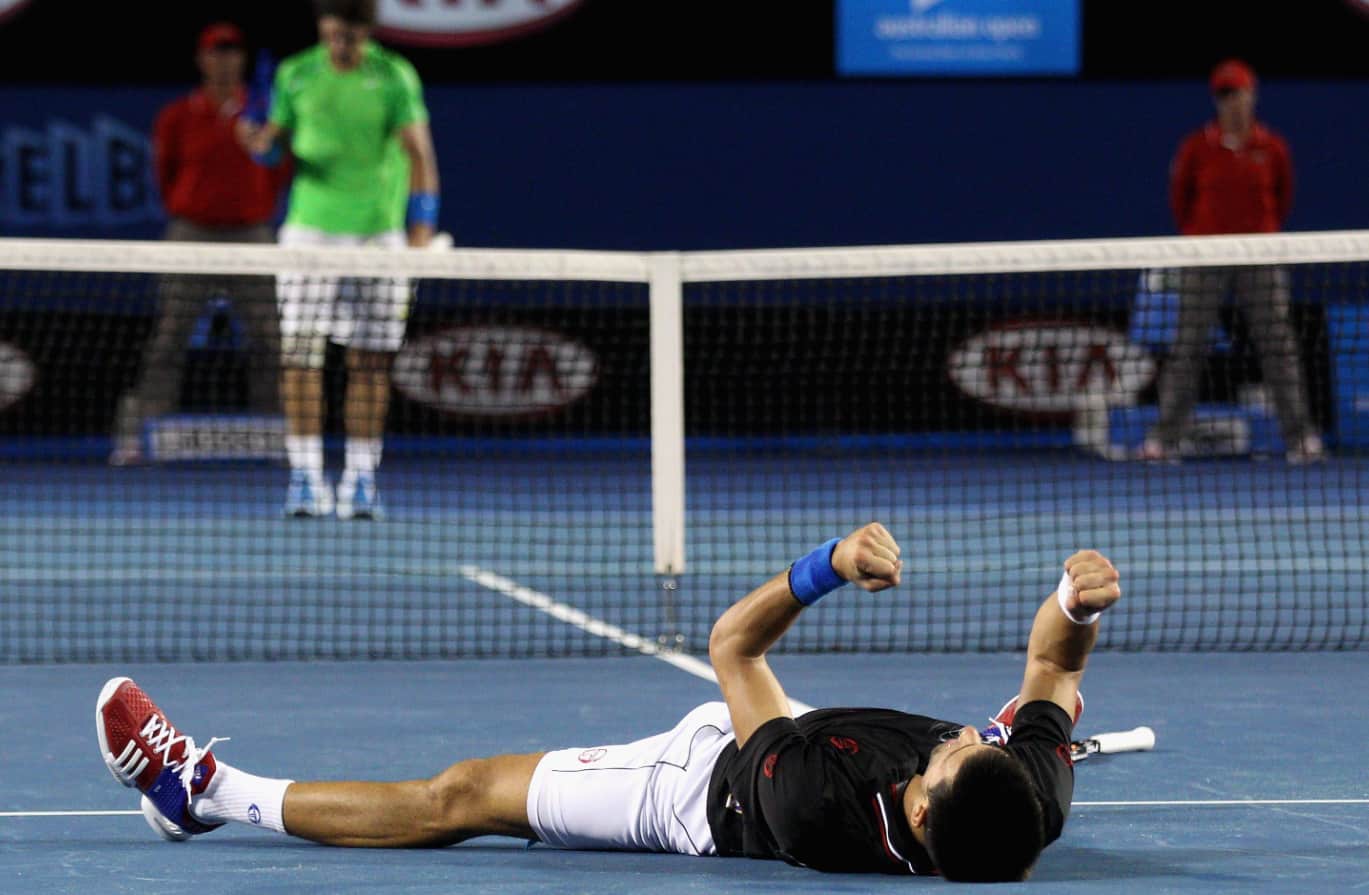
The match lasted 5 hours and 53 minutes total. Djokovic won 5-7, 6-4, 6-2, 6-7(5), 7-5 in the championship final.
Post-match physical toll included severe cramping and compromised standing ability during the trophy ceremony.
Both competitors demonstrated extreme exhaustion through reduced mobility and visible physical distress.
This duration established the all-time record for men’s singles at the Australian Open. The match represents the longest final in tournament history across all competitive eras.
Fifth-set construction
The deciding set extended to 12 games with a 7-5 conclusion. Service holds dominated early portions before late breaks determined the outcome.
Neither player maintained a sustained advantage throughout the fifth set. Physical fatigue progressively impacted serve velocity, movement efficiency, and shot selection quality.
The deciding set lasted over 70 minutes independently. Extended baseline rallies and defensive shot-making contributed significantly to cumulative time.
Historical classification
This match holds the top position on every longest tennis match list for men’s Grand Slam finals. The 5:53 duration surpasses all previous Australian Open men’s championship matches.
The match ranks among the documented top 10 longest matches in Australian Open history across all categories. It represents peak endurance requirements in modern professional tennis competition.
2. Andy Murray v Thanasi Kokkinakis – 2023 Second Round
Scheduling and finish time
Match duration reached 5 hours and 45 minutes in the second round. Murray won 4-6, 6-7(7), 7-6(5), 6-3, 7-5 with match completion at 4:05 AM local time.
Late-night scheduling contributed to extended duration through progressive fatigue accumulation. The finish time ranks as the second-latest completion in tournament history.
Temperature differentials between afternoon and late-night sessions affected playing conditions. Night matches experience distinct environmental variables, including humidity and court surface cooling.
Momentum changes
Murray lost the opening two sets before recovering in the third. The third-set tiebreak prevented a straight-sets conclusion.
Control shifted multiple times without sustained dominance periods. Kokkinakis held a 5-2 lead in the third set before Murray’s recovery.
The fifth set extended to 12 games total. Neither player established a commanding advantage during the deciding set.
Tournament-wide relevance
This duration qualifies for discussion regarding the longest tennis match in one day at the venue. Single-session completion distinguished it from overnight-suspended matches.
The second-round stage demonstrates that marathon durations occur regardless of tournament progression. Early-round matches can equal or exceed later-stage encounter durations.
3. Rafael Nadal v Daniil Medvedev – 2022 Final
Rally length and tempo
Nadal won 2-6, 6-7(5), 6-4, 6-4, 7-5 after 5 hours and 24 minutes. The match featured extended baseline exchanges throughout.
Longer rally patterns increased cumulative match time significantly. Defensive positioning and counter-attacking shot construction prevented rapid point conclusions.
Medvedev held multiple break opportunities in the third set at 0-40. Failed conversions during this critical juncture enabled momentum shifts extending match duration.
Deciding-set workload
The fifth set consumed approximately 80 minutes. It extended to 12 games with consistent service hold patterns.
Physical demands intensified during the deciding set period. Both players exhibited visible fatigue indicators, including reduced court coverage and extended recovery intervals between points.
The final set featured multiple deuce games. Extended individual game durations contributed substantially to overall fifth-set time.
Historical placement
This match ranks as the longest men’s final in a decade at the tournament. The duration positions it among the top 10 longest tennis matches in Australian Open documented history.
Recovery from a two-set deficit required exceptional physical reserves. Such comebacks typically extend match durations beyond standard three or four-set conclusions.
4. Ivo Karlovic v Horacio Zeballos – 2017 First Round
Serve-based match structure
The match duration reached 5 hours and 15 minutes in the opening round. Karlovic won 6-7(6), 3-6, 7-5, 6-2, 22-20.
Serve-dominant competitors typically produce longer matches through frequent service hold patterns. Karlovic recorded 76 aces total, establishing an Australian Open single-match record.
Breakpoint conversion opportunities occurred infrequently throughout. High first-serve percentage success prevented regular service break occurrences.
Extended deciding set
The final set extended to 42 games with a 22-20 conclusion. This decision set alone consumed 157 minutes.
The 22-20 score represents the highest-scoring final set during the tiebreak era at the tournament. It ranks among the most games played in any Australian Open deciding set historically.
Service dominance prevented an earlier match conclusion. Both players held serve repeatedly despite accumulating fatigue across nearly three hours.
Statistical relevance
This match holds significance in the longest tennis game, not match classification discussions. The 42-game final set represents extreme individual set duration parameters.
The first-round timing made this match notable within extreme-duration documentation. Opening-round marathons occur with less frequency compared to later-stage encounters.
5. Rafael Nadal v Fernando Verdasco – 2009 Semifinal
Semifinal pressure context
Nadal won 6-7(4), 6-4, 7-6(2), 6-7(1), 6-4 after 5 hours and 14 minutes. The semifinal stage featured high-stakes competitive pressure throughout.
The match represented the first all-Spanish Grand Slam semifinal since 2003. Both competitors maintained elevated performance standards despite extended duration.
Verdasco required over three hours in his preceding match. Accumulated fatigue from earlier tournament rounds potentially impacted endurance capacity.
Fifth-set tension mechanics
The deciding set extended to 10 games with a 6-4 conclusion. Service breaks occurred in the final games, determining the match outcome.
Verdasco committed two double faults in the final game. These execution errors under pressure concluded the fifth set within standard game count parameters.
The fifth set lasted approximately 60 minutes. This represented a shorter duration compared to other matches on this list despite comparable total match time.
Career-level impact
This match preceded Nadal’s first Australian Open championship. The semifinal victory enabled finals progression two days later.
The duration ranks fifth among the longest MEN’S SINGLES matches in Australian Open history through 2026. It represents late-2000s competitive endurance standards before rule modifications.
The all-left-handed competitor matchup featured specific tactical characteristics. Playing style combinations influence rally length patterns and cumulative match duration outcomes.
Conclusion:
The longest men’s singles matches in Australian Open history 2026 demonstrate quantifiable patterns:
- Match duration escalation patterns: Five documented encounters exceeded 5:14, with peak duration reaching 5:53.
- Physical limits in men’s tennis: Extended matches without final set tiebreakers tested maximum cardiovascular capacity and muscular endurance limits.
- Comparison with longest French Open match ever: Clay court marathons exhibit different duration characteristics due to surface speed differentials and rally construction patterns.
- Relation to longest Grand Slam final: The 2012 Djokovic-Nadal encounter holds the record as the longest Grand Slam final in Open Era history.
- Why Australian Open conditions enable marathon matches: Hard court surfaces, Melbourne scheduling practices, and historical unlimited final set rules produced extreme durations. The second-longest match in Wimbledon history occurred under different grass court conditions. Recent tiebreaker rule implementations restrict future extreme-duration match development.
These records establish measurable benchmarks for physical endurance capacity in men’s professional tennis competition.
Also Check: Longest Women’s Singles Matches in Australian Open History
About the Author